
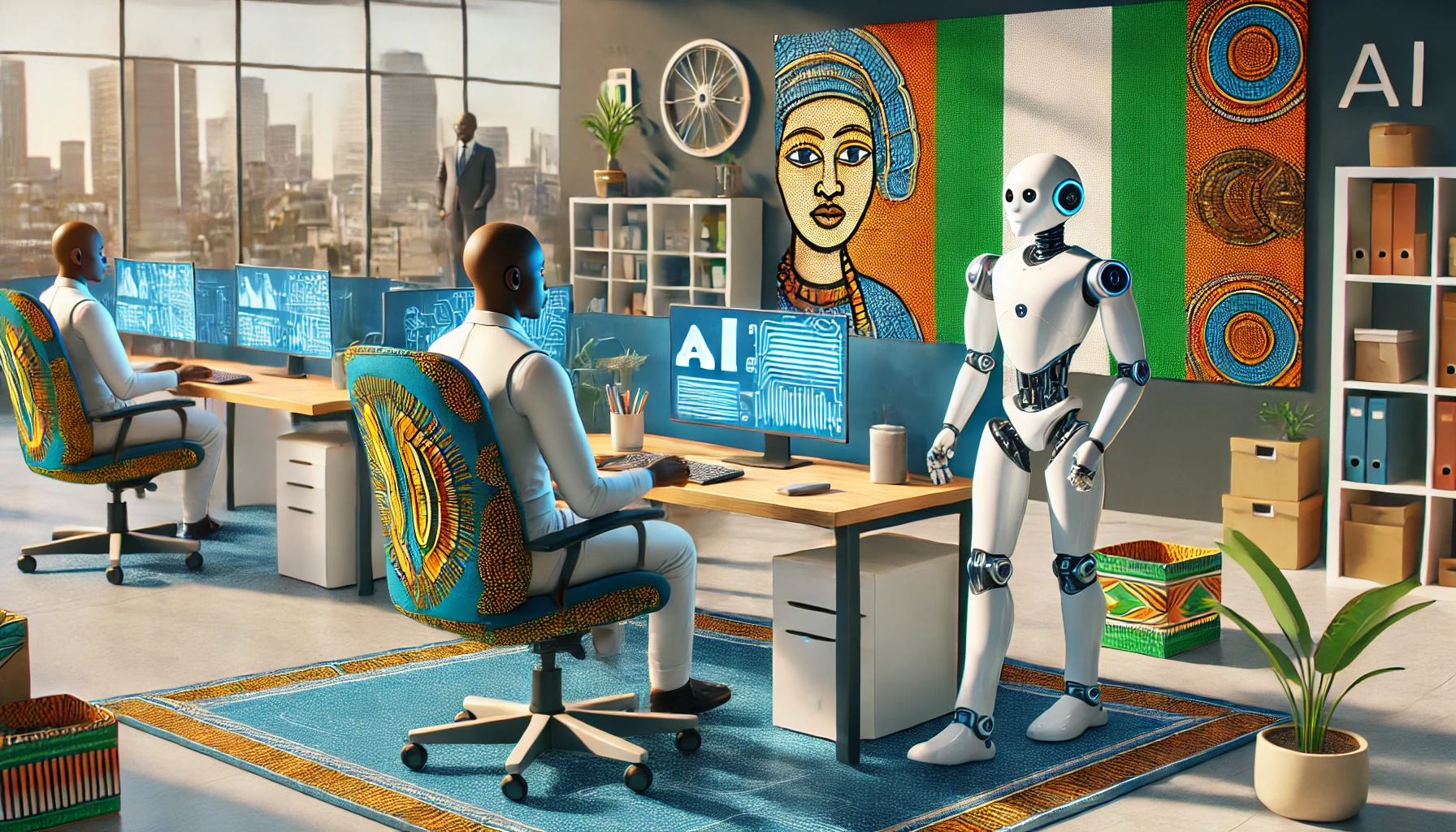
AI and Job Creation in Nigeria: A Threat or an Opportunity?
Introduction
In a bustling Lagos office, Tunde, a young bank teller, watches as a sleek new AI-powered machine takes over most of his daily tasks—counting cash, verifying signatures, and even handling customer inquiries. He feels a knot in his stomach. What if this machine replaces me?
Meanwhile, across town, Ada, a software developer, is excitedly working on an AI-driven chatbot for a fintech startup. She sees AI not as a threat, but as an opportunity—one that creates new jobs, fosters innovation, and transforms industries.
This contrast between fear and optimism reflects the reality of AI in Nigeria. Some worry that AI will replace human jobs, leaving thousands unemployed, while others see it as a powerful tool for economic growth and job creation.
So, is AI a job killer or a job creator in Nigeria? Let’s dive deeper into this debate and uncover the real impact of AI on the Nigerian workforce.
Understanding AI in the Nigerian Context
AI refers to computer systems that can perform tasks that typically require human intelligence, such as learning, reasoning, problem-solving, and decision-making. In Nigeria, AI is already making its mark in various industries, including:
- Finance: AI-powered chatbots and fraud detection systems improve banking services.
- Healthcare: AI assists in medical diagnoses and patient care.
- Agriculture: AI-driven precision farming helps farmers improve yields.
- Retail & E-commerce: AI personalizes shopping experiences and optimizes supply chains.
- Education: AI-powered learning platforms offer customized learning experiences.
As AI continues to grow, it raises concerns about job security. But is this concern justified?
AI as a Job Killer: The Threat Perspective
Many fear that AI will replace human jobs, especially in routine and repetitive tasks. Some of the threats include:
1. Automation of Low-Skilled Jobs
AI-driven machines and software can perform repetitive tasks faster and more accurately than humans. This could lead to job losses in sectors like banking, customer service, manufacturing, and transportation.
2. Mismatch of Skills
AI creates a demand for new technical skills, such as programming and data analysis. However, Nigeria’s current education system does not adequately prepare workers for these roles, leaving many unemployed.
3. Increased Economic Inequality
AI-driven job losses could widen the gap between skilled and unskilled workers, leading to greater economic inequality in Nigeria.
4. Dependence on Foreign AI Solutions
If Nigeria does not develop its own AI solutions, companies may rely on foreign technology, leading to fewer local job opportunities.
Read More: Transforming Nigeria’s Healthcare System with AI: Possibilities and Challenges
AI as a Job Creator: The Opportunity Perspective
Despite the threats, AI has the potential to create more jobs than it displaces. Here’s how:
1. New Job Roles and Industries
AI is creating demand for new job roles such as:
- AI Engineers
- Data Scientists
- Machine Learning Experts
- Cybersecurity Analysts
- AI Trainers & Ethics Experts
As AI adoption increases, Nigeria can develop industries around AI development, implementation, and maintenance, generating thousands of jobs.
2. Enhanced Productivity and Economic Growth
AI improves efficiency in various industries, allowing businesses to expand and create more jobs. For example:
- AI-powered automation can help farmers increase food production, leading to more agricultural jobs.
- AI-driven healthcare solutions can improve patient care, creating more roles for medical professionals.
3. Entrepreneurship and Startups
AI provides opportunities for Nigerian entrepreneurs to develop innovative AI-driven solutions for local challenges, from fintech to agri-tech. This can lead to the growth of a robust AI startup ecosystem.
Rather than replacing jobs, AI can enhance human capabilities. For example:
- AI-powered diagnostic tools help doctors make faster and more accurate diagnoses.
- AI-driven customer service tools assist agents in providing better service.
- AI-based financial tools help businesses make smarter investment decisions.
5. Growth of AI Training and Education
As demand for AI-related skills grows, new educational institutions and training centers will emerge, creating employment for educators, trainers, and curriculum developers.
The Way Forward: Maximizing AI’s Potential in Nigeria
To harness AI’s job-creating potential while mitigating risks, Nigeria must take proactive steps:
1. Invest in Education and Reskilling
- Universities should introduce AI-related courses.
- Government and private sectors should fund AI training programs.
- Workers in traditional industries should be reskilled to work alongside AI.
2. Promote AI Research and Development
- Nigeria should invest in AI research to develop local AI solutions.
- Collaboration between universities, businesses, and the government can foster AI innovation.
3. Support AI Entrepreneurship and Startups
- The government should create policies that encourage AI startups.
- Funding and grants should be made available to AI entrepreneurs.
4. Regulate AI to Ensure Ethical Use
- AI should be developed and used responsibly to avoid job displacement.
- Policies should be in place to ensure fair wages and worker protections.
5. Encourage Public-Private Partnerships
- The government and private sector should collaborate to implement AI solutions that create jobs and drive economic growth.
Read More: How The Application Of AI Can Be Used To Solve Insecurity In Nigeria
Final Verdict: AI—A Threat or an Opportunity?
AI is not inherently a threat or an opportunity—it is a tool. How Nigeria leverages AI will determine whether it leads to job losses or job creation. If Nigeria invests in AI education, research, and entrepreneurship, AI can drive massive job growth and economic prosperity.
Instead of fearing AI, Nigeria should embrace it as a catalyst for innovation, job creation, and national development. The future of work is not about AI replacing humans but about AI augmenting human potential.
Frequently Asked Questions (FAQs)
1. Will AI take away jobs in Nigeria?
AI will automate some repetitive tasks, leading to job displacement in certain sectors. However, it will also create new job opportunities in AI development, data science, and other tech-driven industries.
2. What industries in Nigeria will benefit the most from AI?
Industries like finance, healthcare, agriculture, education, and e-commerce will see significant improvements through AI-driven efficiency and innovation.
3. How can Nigeria prepare its workforce for AI?
Nigeria must invest in AI education, reskilling programs, and promote local AI development to ensure its workforce is ready for the AI-driven future.
4. Can AI create jobs for non-tech professionals?
Yes! AI will create jobs in AI ethics, legal compliance, marketing, healthcare, and even creative industries like music and film production.
5. What role should the government play in AI job creation?
The government should support AI research, fund AI education programs, promote AI entrepreneurship, and create policies to ensure ethical AI use.
Conclusion
AI is neither an absolute threat nor a guaranteed opportunity—it all depends on how Nigeria chooses to approach it. By embracing AI strategically, investing in human capital, and fostering innovation, Nigeria can turn AI into a powerful engine for job creation and economic growth.
The future is not about AI replacing Nigerian workers but about Nigerian workers harnessing AI to build a stronger, more prosperous economy.
What do you think? Is AI a threat or an opportunity for job creation in Nigeria? Let’s discuss!



Pingback: How to Become a Successful AI Engineer - Newline Tech
Great goods from you, man. I’ve understand your stuff previous to and you are just too excellent.
I really like what you’ve acquired here,
really like what you’re stating and the way in which you say it.
You make it entertaining and you still take care of to keep it
wise. I can’t wait to read much more from you. This is actually a great
web site.
An impressive share! I have just forwarded this onto a coworker who has been conducting a little homework on this. And he actually ordered me breakfast because I stumbled upon it for him… lol. So allow me to reword this…. Thanks for the meal!! But yeah, thanx for spending some time to talk about this matter here on your blog.
It is truly a great and helpful piece of information. I’m glad that you just shared this useful info with us. Please keep us informed like this. Thank you for sharing.
This is a topic that’s near to my heart… Best wishes! Where are your contact details though?
Aw, this was an incredibly good post. Spending some time and actual effort to generate a superb article… but what can I say… I hesitate a whole lot and never manage to get nearly anything done.
Your way of describing everything in this piece of writing is truly pleasant, all be able to effortlessly understand it, Thanks a lot.
Wow that was unusual. I just wrote an incredibly long comment but after I clicked submit my comment didn’t appear. Grrrr… well I’m not writing all that over again. Anyway, just wanted to say superb blog!
Can I just say what a relief to find somebody who genuinely understands what they’re talking about online. You definitely realize how to bring an issue to light and make it important. A lot more people really need to look at this and understand this side of your story. I was surprised you aren’t more popular because you surely have the gift.
Currently it sounds like Drupal is the top blogging platform out there right now. (from what I’ve read) Is that what you are using on your blog?