
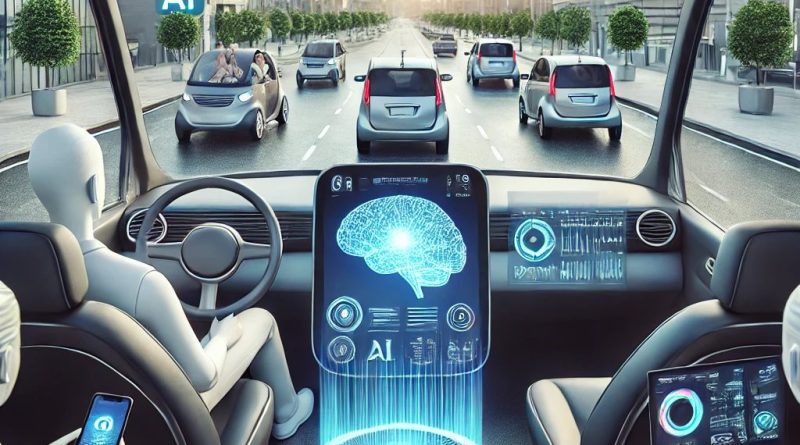
No Hands, All Brain: The AI Revolution in Self-Driving Cars
The Day the Steering Wheel Became Optional
It was a regular Monday morning in 2025. Sarah, a software engineer in San Francisco, sipped her coffee as she reviewed her morning emails—not from her desk, but from the plush leather seat of her car. There was no steering wheel in sight. No foot hovered nervously over a brake. The only thing guiding her vehicle down the highway was an intricate ballet of sensors, neural networks, and artificial intelligence making decisions with precision that rivaled the sharpest human minds.
A decade ago, this scenario would’ve belonged to a sci-fi movie. Today, it’s becoming our everyday reality. Welcome to the AI revolution in self-driving cars—where human hands are off the wheel, but the brain power behind the wheel has never been stronger.
How We Got Here: A Quick Look Back
The dream of autonomous driving isn’t new. In fact, it dates back to the early 20th century when engineers first toyed with the idea of remote-controlled vehicles. By the 1980s, universities like Carnegie Mellon were experimenting with rudimentary forms of robotic cars. In 2004, the DARPA Grand Challenge gave the world its first taste of what self-driving cars could achieve, sparking innovation across the globe.
Fast forward to the 2010s, and companies like Tesla, Google (Waymo), and Uber began investing billions into autonomous vehicle research. What made these leaps possible? One key ingredient: artificial intelligence.
The Brain Behind the Wheel: How AI Powers Self-Driving Cars
Self-driving cars aren’t just about wheels and engines—they’re about sensors, code, and intelligence.
AI allows vehicles to “see” the world using a combination of LiDAR (light detection and ranging), cameras, radar, GPS, and ultrasonic sensors. Together, they help the vehicle detect road signs, pedestrians, lane markings, traffic lights, other vehicles, and even road textures.
2. Real-Time Decision-Making:
Once the car sees its environment, AI steps in to make sense of it. Computer vision identifies objects, deep learning predicts their movement, and decision-making algorithms determine how to respond. Should the car slow down for a pedestrian? Change lanes to avoid an obstacle? AI handles it all, often faster than a human could react.
3. Path Planning and Control:
AI also figures out the best route to take and how to follow it. This includes steering, acceleration, braking, and adjusting speed in real time. These systems constantly update themselves based on new data from the environment.
4. Machine Learning and Continuous Improvement:
Self-driving cars improve over time. Machine learning enables vehicles to learn from data collected during every trip—learning how to drive better, spot new hazards, and adapt to unfamiliar environments.
Read More: Top AI Tools Revolutionizing Music Production in Nigeria: Elevate Your Sound
Levels of Autonomy: From Helper to Hero
The journey toward full autonomy is broken into levels, from Level 0 (no automation) to Level 5 (full autonomy).
• Level 0: Human drivers do everything.
• Level 1: Basic driver assistance like cruise control or lane keeping.
• Level 2: The car can steer and control speed simultaneously, but the driver must stay engaged.
• Level 3: The car handles most driving tasks, but the driver must be ready to intervene.
• Level 4: Full autonomy in controlled environments, like city centers or campuses.
• Level 5: Full self-driving in all conditions, with no need for human input at all.
Most of today’s cars fall between Level 2 and Level 3. But companies like Waymo and Cruise are actively testing Level 4 vehicles in urban areas.
Why AI Driving Might Be Better Than Humans
AI drivers have several advantages over humans:
• Lightning-Fast Reaction Time: AI reacts in milliseconds—far faster than the average human.
• No Distractions or Fatigue: AI doesn’t text, drink coffee, get sleepy, or check Instagram while driving.
• 360-Degree Awareness: While humans have blind spots, AI systems monitor everything around the vehicle, all the time.
• Consistent Performance: Unlike humans who vary in skill, AI performs at the same high standard every trip.
Of course, AI isn’t flawless. It can struggle with unpredictable scenarios, like unusual pedestrian behavior or bizarre traffic conditions. But in many measurable ways, it’s already outperforming human drivers.
Who’s Leading the AI Self-Driving Race?
Several tech giants and automakers are racing toward the finish line of full autonomy:
• Waymo (backed by Google) is running fully autonomous taxi services in places like Phoenix and San Francisco.
• Tesla continues to evolve its Autopilot and Full Self-Driving systems, offering features like auto lane changes and traffic light recognition.
• Cruise, supported by General Motors, has rolled out fully autonomous vehicles in multiple U.S. cities.
• Nuro is focusing on autonomous delivery vehicles—small, driverless pods that carry groceries or takeout food.
These companies—and others like Apple, Zoox, and Nvidia—are pushing the boundaries of what AI can do on the road.
Read More: AI-Powered Generative Tools Revolutionizing Content Creation
What’s Holding Back Full Adoption?
Despite all the progress, a few major roadblocks remain:
1. Unpredictable Scenarios: AI still struggles with “edge cases”—situations it hasn’t seen before, like an animal running into traffic or a pedestrian wearing an inflatable dinosaur costume.
2. Ethical Dilemmas: What should a car do in a no-win situation, like choosing between hitting a pedestrian or swerving into traffic? These philosophical challenges are hard to program.
3. Regulatory Uncertainty: Laws around autonomous vehicles differ by country—and even by state. Governments are still figuring out how to regulate AI drivers.
4. Public Trust: Many people feel uneasy letting AI drive them around. Gaining trust will take time, testing, and transparency.
5. Cybersecurity: A hacked car could pose massive safety risks. Ensuring iron-clad cybersecurity is a top priority.
FAQs About AI in Self-Driving Cars
Q: Are self-driving cars safe?
Yes, and in many cases, they are safer than human drivers. AI systems don’t get distracted or tired. However, they still have limitations and must be tested rigorously.
Q: Can I legally sleep while my self-driving car drives?
Not yet. Even in vehicles with advanced autonomous features, drivers are still legally required to remain alert and ready to take over.
Q: How does a car’s AI learn to drive?
Through a mix of real-world driving data, simulations, and supervised learning where the AI is trained to recognize patterns, rules, and potential hazards.
Q: Will AI eliminate traffic accidents completely?
Probably not 100%, but AI is expected to reduce accidents dramatically—some estimates suggest by over 90% once fully adopted.
Q: Which companies are the biggest players in AI self-driving tech?
Tesla, Waymo, Cruise, Nvidia, Apple, Zoox, and Amazon-backed startups are leading the charge.
Conclusion: From Wheels to Wisdom
We’re living in an age where the word “driver” might soon become obsolete. AI has shifted from being a helpful assistant to being the full-time pilot of our journeys. With the power of sensors, algorithms, and constant learning, our cars are becoming safer, smarter, and more aware than ever.
The roads of tomorrow won’t just be filled with electric cars—they’ll be filled with intelligent ones. So, the next time you see a car cruising smoothly without a driver, remember: it’s not hands at the wheel anymore—it’s all brain.



Sweet blog! I found it while searching on Yahoo News.
Do you have any suggestions on how to get listed in Yahoo News?
I’ve been trying for a while but I never
seem to get there! Thank you
Pretty nice post. I just stumbled upon your weblog and wished to say that I’ve really enjoyed browsing your blog posts. In any case I’ll be subscribing to your rss feed and I hope you write again soon!
Wow, fantastic weblog structure! How long have you ever been running a blog for? you made blogging glance easy. The total look of your site is fantastic, as smartly as the content
It’s perfect time to make some plans for the future and it’s time to be happy.
I have read this post and if I could I wish to suggest you few interesting things or
advice. Perhaps you can write next articles
referring to this article. I want to read more things about it!
Have you ever thought about writing an e-book or guest authoring on other blogs? I have a blog based upon on the same ideas you discuss and would really like to have you share some stories/information. I know my audience would appreciate your work. If you’re even remotely interested, feel free to shoot me an e-mail.
Oh my goodness! Amazing article dude! Thanks, However I am having troubles with your RSS. I don’t understand why I cannot subscribe to it. Is there anybody else having similar RSS issues? Anybody who knows the answer can you kindly respond? Thanx!!