

How NVIDIA Emerged as the Most Critical Hardware Company Powering the AI Revolution
Introduction
A few decades ago, most people associated computer graphics with gaming and entertainment. Powerful graphics cards were mainly built to render video games and visual effects.
But behind the scenes, a quiet transformation was taking place. Those same chips designed for graphics were perfectly suited for handling complex calculations. Fast forward to today, and those chips are now the backbone of artificial intelligence.
At the center of this transformation is NVIDIA, a company that has become one of the most important players in the AI era. Its hardware powers everything from chatbots to self-driving cars, making it a cornerstone of modern technology.
The Origins of NVIDIA
NVIDIA was founded with a focus on graphics processing units, commonly known as GPUs. These chips were designed to handle the intense visual computations required for gaming and 3D rendering.
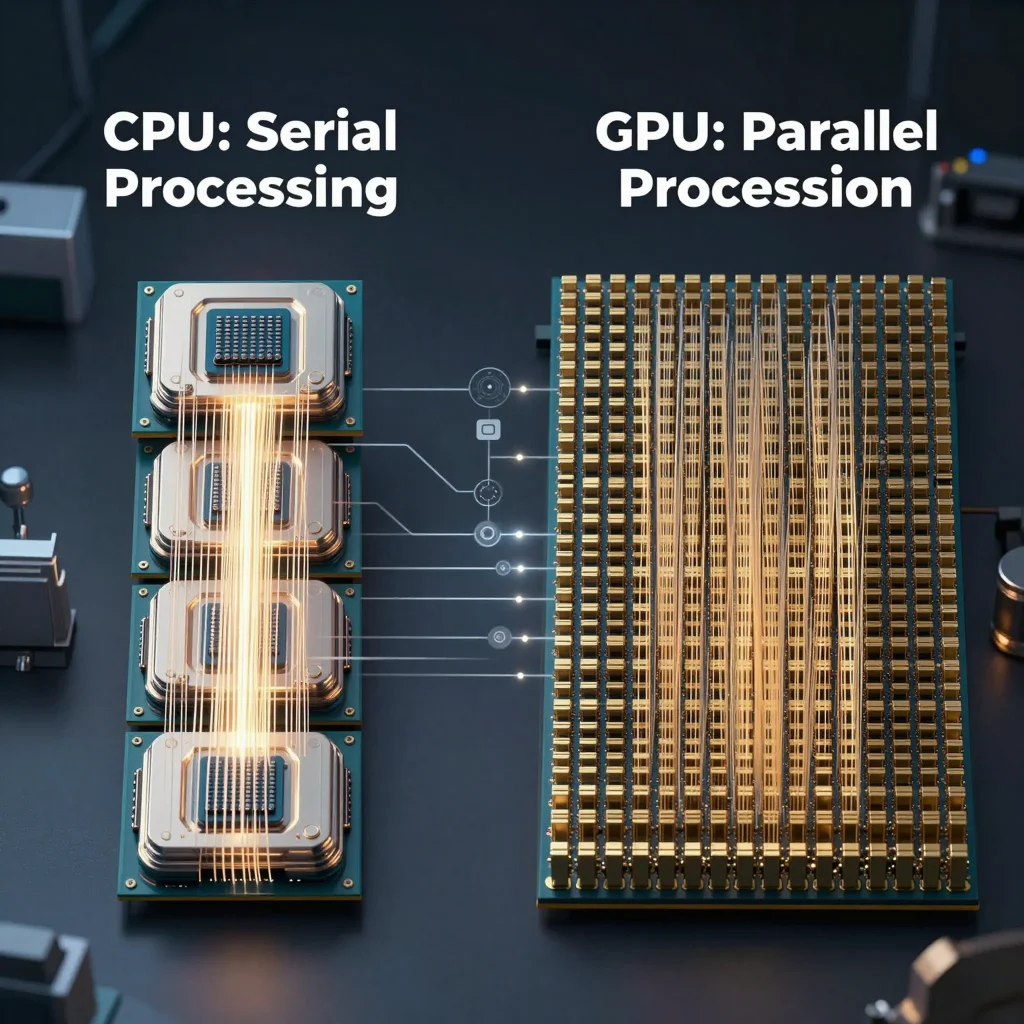
Unlike traditional CPUs, GPUs can process many tasks simultaneously. This parallel processing capability made them ideal for handling large datasets and complex mathematical operations.
Over time, developers realized that GPUs could be used for more than graphics. This discovery laid the foundation for NVIDIA’s role in artificial intelligence.
The Shift From Gaming to AI
The real breakthrough came when GPUs were applied to machine learning. Training AI models requires massive computational power, and GPUs proved to be far more efficient than CPUs for this task.
NVIDIA invested heavily in this direction, developing hardware and software tailored for AI workloads.
The company introduced platforms and tools that made it easier for researchers and developers to build AI models.
As AI adoption grew, NVIDIA’s technology became essential across industries.
Read More: How Google Rose to Become the World’s Most Dominant Search Engine
Table: GPU vs CPU for AI Workloads
| Hardware | Key Advantage |
|---|---|
| GPU (NVIDIA) | Parallel processing for faster AI training |
| CPU | General purpose computing |
| GPU (NVIDIA) | Efficient handling of large datasets |
| CPU | Limited scalability for AI tasks |
Read More: A Deep Look Into Apple’s Highly Secretive Product Development Strategy
Key Technologies Driving NVIDIA’s Success
Several innovations have contributed to NVIDIA’s dominance.
First, its GPUs are optimized for high-performance computing. They can process large volumes of data quickly and efficiently.
Second, NVIDIA developed software ecosystems that support AI development. These tools make it easier to build and deploy machine learning models.
Another key factor is continuous innovation. The company regularly releases new hardware with improved capabilities.
It also collaborates with major tech companies, integrating its technology into cloud platforms and data centers.
These factors have positioned NVIDIA as a leader in AI hardware.
Impact on the AI Industry
NVIDIA plays a central role in powering AI systems worldwide.
Companies developing AI models rely on NVIDIA GPUs for training and deployment.
Cloud providers use their hardware to deliver AI services at scale.
Research institutions depend on their technology for scientific advancements.
This widespread adoption has made NVIDIA a critical part of the global AI infrastructure.
Real World Applications
NVIDIA’s hardware supports a wide range of applications.
AI chatbots and virtual assistants rely on their GPUs for processing.
Autonomous vehicles use their technology to analyze data and make decisions.
Healthcare systems use AI powered by NVIDIA to improve diagnostics.
Gaming and content creation continue to benefit from its graphics capabilities.
These applications highlight the versatility of NVIDIA’s technology.
Future of NVIDIA in the AI Era
NVIDIA is expected to remain a key player in the AI industry.
As AI models become more complex, the demand for powerful hardware will continue to grow.
NVIDIA is likely to develop even more advanced chips and platforms to meet this demand.
Competition is increasing, but NVIDIA’s strong ecosystem and innovation give it a significant advantage.
The company’s role in shaping the future of AI will likely expand even further.
Read More: How SpaceX Is Revolutionizing Global Internet Access Through Starlink Satellite Technology
Frequently Asked Questions
Why are NVIDIA GPUs important for AI?
They offer parallel processing, which allows faster training and execution of AI models.
How did NVIDIA become a leader in AI?
By adapting its GPU technology for machine learning and investing in AI-focused tools and platforms.
Are GPUs better than CPUs for AI?
For many AI tasks, GPUs are more efficient due to their ability to process multiple operations simultaneously.
Will NVIDIA remain dominant in the future?
While competition exists, NVIDIA’s innovation and ecosystem position it strongly in the AI market.
Conclusion
NVIDIA’s journey from a graphics company to a leader in AI hardware is a story of innovation and vision.
By recognizing the potential of GPUs beyond gaming, the company positioned itself at the center of the AI revolution.
Today, NVIDIA powers some of the most advanced technologies in the world, and its influence continues to grow.
As artificial intelligence evolves, NVIDIA will remain a key force driving the future of computing.


Pingback: How ByteDance Turned TikTok Into One of the World’s Fastest-Growing Apps - Latest AI/Tech Info
Pingback: Inside Microsoft’s Strategic Shift to Cloud Computing and Its Business Impact - Latest AI/Tech Info
Pingback: How Spotify Uses Machine Learning to Deliver Personalized Music Experiences - Latest AI/Tech Info
Pingback: Understanding the Business Model Powering Cloud Giants Like AWS, Azure, and Google Cloud - Latest AI/Tech Info