

Two Minds Are Better Than One and Google’s Gemini Proves It
The Power of Collaboration in a Digital Age
It started in a garage.
Two friends stared at a whiteboard covered in scribbles. Lines connected thoughts, questions hung in circles, and a single phrase loomed larger than the rest: Make machines understand humans.
One friend was an engineer. The other, a linguist. At first, their ideas clashed. The engineer wanted structure. The linguist wanted meaning. But as they argued, they started to build something neither could have created alone. Together, they launched a prototype that could process language in a way no machine had done before. That garage moment became the seed for something much bigger.
Years later, that same spirit of collaboration echoes through Google’s groundbreaking AI project Gemini. And it proves what we’ve always known to be true: Two minds are better than one.
Read More: Big Tech AI Investments – Microsoft, Google, and Meta racing to dominate AI development
The Evolution of AI and the Gemini Revelation
When it comes to artificial intelligence, we often imagine machines thinking independently. But Google’s Gemini flips the narrative. Instead of building a lone genius machine, Gemini blends the power of multimodal thinking where vision, language, and logic work in tandem. It’s not just about raw computing. It’s about collaboration. It’s about synergy. It’s the digital equivalent of two expert minds working together in perfect harmony.
Unlike older AI models that excelled in one domain but struggled to generalize, Gemini combines multiple forms of intelligence. It sees. It reads. It reasons. It adapts. Most importantly, it integrates these faculties like a human team would, each strength compensating for another’s weakness.
Why Gemini Is the AI Manifestation of “Two Heads Are Better Than One”
Humans thrive on collaboration. History proves this. From the Wright brothers designing the first airplane to Marie and Pierre Curie exploring radioactivity, the most world-changing ideas came not from solitary geniuses but from dynamic duos.
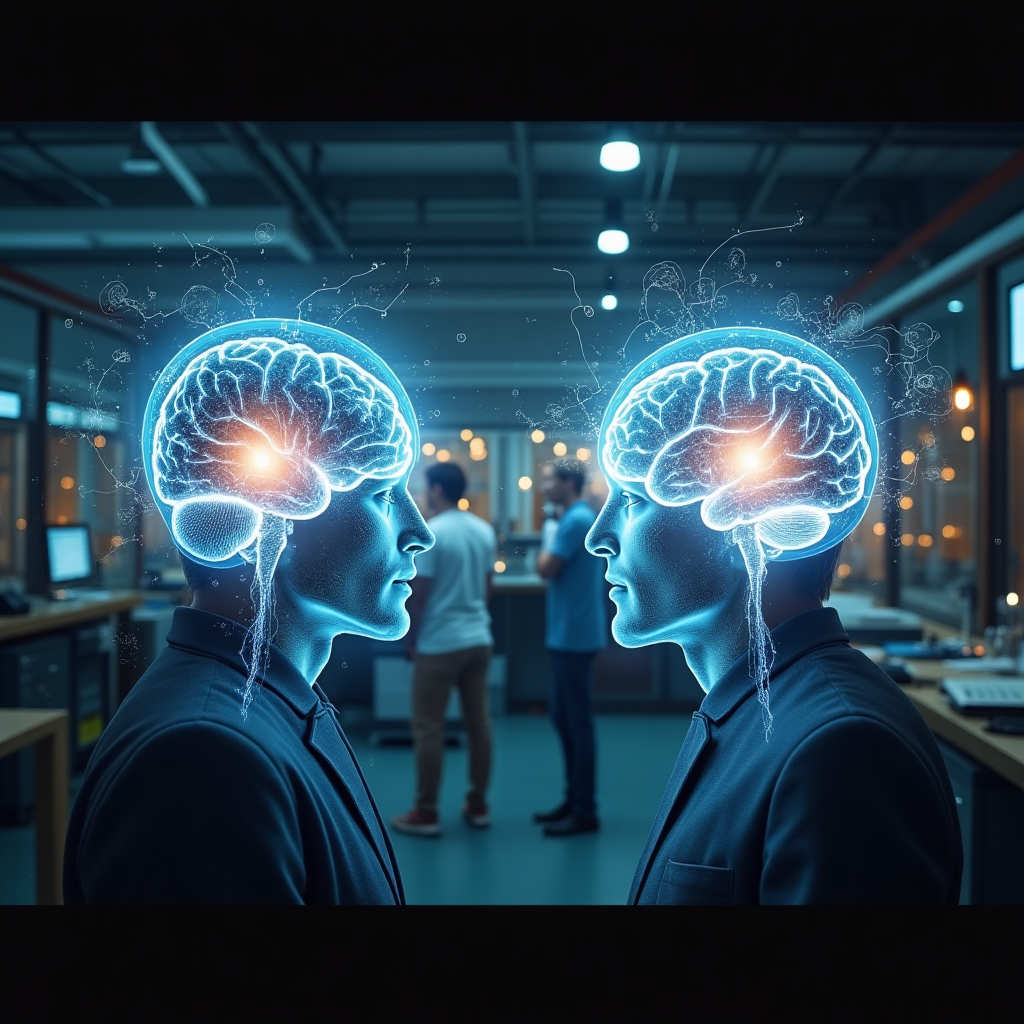
Gemini operates on this principle. It doesn’t think in a linear silo. It connects vision with verbal context, math with emotion, language with logic. It’s as if Gemini carries multiple brains, each skilled in its own domain, communicating internally in milliseconds.
This multimodal capacity allows Gemini to:
- Understand images and describe them in natural language
- Read long documents and provide coherent summaries
- Solve complex problems by integrating logic and creativity
- Recognize nuance in conversation the way humans do
Just as two people with different strengths create a more powerful solution together, Gemini shows that multiple cognitive systems fused together can outperform any single-minded AI.
Read More: AI-Powered Search Wars – Google’s Gemini vs. OpenAI’s rumored AI-powered search engine.
The Story Behind Gemini: More Than Just Tech
The development of Gemini didn’t happen overnight. It emerged from Google DeepMind’s ambition to push beyond traditional AI boundaries. By combining cutting-edge neural networks with a deep understanding of human communication, Gemini represents not only technological prowess but a philosophical shift.
In the past, machines mimicked intelligence. Gemini builds it collaboratively from the ground up.
Behind every line of code was a team of researchers, engineers, linguists, and ethicists working together. The product isn’t just a model. It’s a testament to the belief that when different minds come together, magic happens.
How Gemini’s Collaboration Model Impacts the Real World
Gemini’s collaborative intelligence has direct implications across industries. Let’s look at a few examples:
1. Healthcare Diagnostics
Gemini can combine visual input (like an MRI scan) with patient data and clinical notes to offer insights no single system could generate. Doctors and AI now work like co-pilots.
2. Education
Imagine a tutor that understands your handwritten math problems, explains them using voice, suggests relevant videos, and adapts to your learning style. That’s not science fiction anymore.
3. Creative Industries
Writers, designers, and musicians can use Gemini to brainstorm, critique, and refine ideas in real time. It’s a true collaborator, not just a tool.
Read More: How AI Could Be the Unexpected Hero in Humanity’s Quest for World Peace
Frequently Asked Questions (FAQ)
What is Google Gemini?
Gemini is a multimodal AI model developed by Google DeepMind. It integrates language, vision, and logic to understand and interact in complex ways, offering advanced problem-solving and conversational capabilities.
How is Gemini different from ChatGPT or other language models?
While ChatGPT focuses primarily on text, Gemini blends multiple data forms, images, voice, documents, code, and more into a seamless understanding. It doesn’t just answer questions. It synthesizes across domains.
Can Gemini replace human jobs?
Not exactly. Instead of replacing humans, Gemini aims to augment human capabilities. Think of it as a co-creator, co-thinker, and co-analyzer, empowering professionals rather than replacing them.
Is Gemini safe to use?
Google has emphasized ethical AI development with Gemini. It includes guardrails, bias checks, and ongoing monitoring. However, as with all AI, responsible use and oversight are essential.
Where can I access Gemini?
Google has integrated Gemini into various products, including Google Search, Workspace, and Android. Developers can also access Gemini models through Google Cloud AI Studio.
Conclusion: When Intelligence Collaborates, Innovation Soars
The idea that two minds are better than one has driven human progress for centuries. From scientific discovery to artistic creation, collaboration has always been our superpower.
Now, with Google’s Gemini, that principle extends into the digital realm. We are no longer just teaching machines to think. We are teaching them to think together.
Gemini isn’t just a marvel of engineering. It’s a symbol of what happens when different intelligences, human and machine, natural and synthetic, converge with a shared goal. It proves that creativity and intelligence flourish in connection, not isolation.
So the next time you face a challenge, consider this: the best solution may not lie in one brilliant mind but in two minds working side by side.
And sometimes, one of them might just be artificial.


Pingback: Sorry Terrorists, AI Just Read Your Group Chat and Booked You a Jail Cell - Newline Tech