
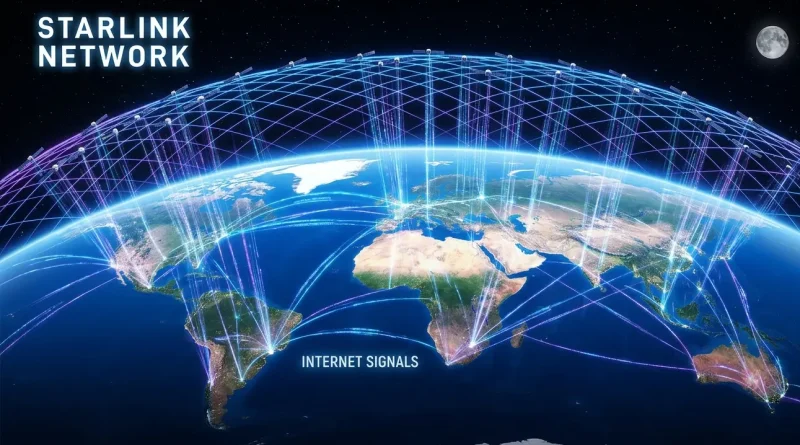
How SpaceX Is Revolutionizing Global Internet Access Through Starlink Satellite Technology
Introduction
For decades, reliable internet access depended heavily on cables buried underground or stretched across oceans. While cities enjoyed fast connections, many rural and remote areas struggled with slow or nonexistent internet. This digital divide limited education, business, and communication opportunities for millions of people.
Then came a bold vision from SpaceX. Instead of relying on ground infrastructure, why not deliver the internet directly from space? That vision led to the creation of Starlink, a project designed to provide high-speed internet anywhere on Earth.
Today, Starlink is reshaping how the world connects, bringing fast and reliable internet to places once considered unreachable.
What Is Starlink Satellite Internet
Starlink is a satellite internet service developed by SpaceX. It uses a network of low Earth orbit satellites to deliver broadband internet globally.
Unlike traditional satellite internet, which relies on a few high-orbit satellites, Starlink operates thousands of smaller satellites closer to Earth. This reduces latency and improves speed.
Users connect to the network using a satellite dish that communicates directly with the satellites overhead. This setup allows internet access even in remote areas without fiber or mobile networks.
Key Technologies Behind Starlink
Several advanced technologies power Starlink’s performance.
One major innovation is low Earth orbit deployment. Satellites positioned closer to Earth reduce signal travel time, resulting in faster connections.
Another key technology is phased array antennas. These allow the user terminal to track satellites automatically without manual alignment.
SpaceX also uses reusable rockets to launch satellites efficiently. This reduces costs and enables rapid expansion of the network.
Additionally, inter-satellite laser links allow satellites to communicate with each other in space. This improves data transmission and reduces reliance on ground stations.
Read More: How Amazon Uses Advanced Logistics Technology to Power One of the World’s Fastest Delivery Networks
Table: Starlink vs Traditional Internet Infrastructure
| Technology Type | Key Difference |
|---|---|
| Starlink Satellite Internet | Global coverage, works in remote areas |
| Fiber Optic Internet | High speed but limited to wired locations |
| Traditional Satellite | Higher latency due to distant orbit |
| Mobile Networks | Coverage depends on towers and infrastructure |
Impact on Global Internet Access
Starlink is transforming global connectivity. It brings internet access to rural communities, remote islands, and disaster-affected areas.
This has major implications for education. Students in underserved regions can now access online learning resources.
Businesses can operate in previously disconnected areas, opening new economic opportunities.
Governments and organizations can also use Starlink for emergency communication during crises when traditional networks fail.

Read More: How Netflix Leveraged Data and Technology to Become a Global Streaming Giant
Real World Applications
Starlink is already being used in various real-world scenarios.
In rural areas, it provides reliable internet where fiber networks are unavailable.
In the maritime and aviation sectors, it enables connectivity on ships and airplanes.
During natural disasters, Starlink helps restore communication quickly.
It is also used by researchers and explorers in remote locations where traditional internet is not feasible.
Future of Satellite Internet
SpaceX continues to expand the Starlink network by launching more satellites. This will improve coverage, speed, and reliability.
Future developments may include smaller and more affordable user terminals. This will make the service accessible to more people worldwide.
Competition is also increasing, with other companies exploring satellite internet solutions. This will drive innovation and reduce costs.
As technology advances, satellite internet could become a primary method of global connectivity, bridging the digital divide.
Read More: Why Nokia Dominated Mobile Phones Before the Smartphone Era
Frequently Asked Questions
How fast is Starlink internet?
Starlink offers speeds comparable to broadband, with ongoing improvements as more satellites are deployed.
Can Starlink work anywhere?
Yes, it is designed to provide coverage in most parts of the world, especially in remote and underserved areas.
Is Starlink better than fiber internet?
Fiber internet is still faster in many cases, but Starlink provides access where fiber is not available.
How much does Starlink cost?
Pricing varies by region and includes the cost of equipment and a monthly subscription fee.
Conclusion
SpaceX is transforming the global internet landscape with Starlink.
By leveraging satellite technology, the company is bringing high-speed internet to places that were once disconnected.
As the network continues to grow, Starlink has the potential to bridge the digital divide and redefine how the world stays connected.



Pingback: A Deep Look Into Apple’s Highly Secretive Product Development Strategy - Latest AI/Tech Info
Pingback: How Google Rose to Become the World’s Most Dominant Search Engine - Latest AI/Tech Info